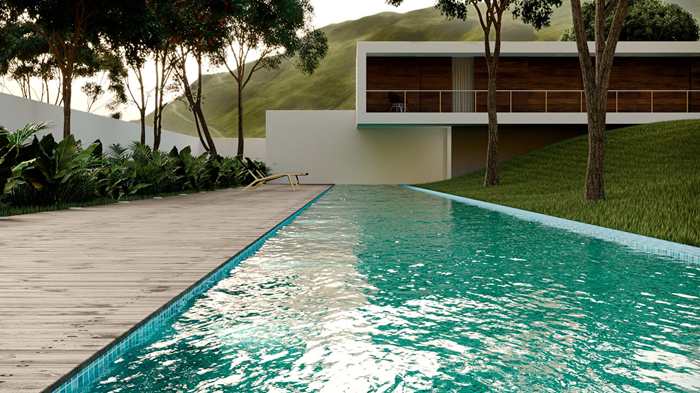
Commercial architectural visualization involves creating photorealistic or stylized images of future real estate developments for the purposes of promotion, sales, and approval processes.
It translates blueprints, schematics, and BIM models into an accessible visual language, making it easier to quickly evaluate the concept, key benefits, and potential use cases for the space.
Unlike artistic renderings or academic projects, commercial visualization is driven by business objectives: increasing lead generation, accelerating investor decision-making, supporting marketing efforts, and minimizing the risk of project misinterpretation. Consequently, accuracy, persuasiveness, adherence to deadlines, and a consistent visual style across various channels—from websites and presentations to billboards and catalogs—are essential.
What Commercial Architectural Visualization Includes
The scope of the package depends on the type of project (residential complex, office building, shopping center, hotel, warehouse, or public space) and the project stage.
Typically, a set of images and supplementary materials is created to showcase the property from both the outside and the inside, highlighting details and context while illustrating intended use scenarios.
Key Formats
- Exterior renderings: façade views, panoramas, eye-level and aerial perspectives, and day/night scenes.
- Interior renderings: lobbies, corridors, standard and premium areas, commercial spaces, and showrooms.
- Layout visuals: floor and apartment plans, zoning diagrams, and furnishing layouts.
- Animation and video: fly-throughs, walkthroughs, and clips for advertising and social media.
- 360° and interactive content: virtual tours, finish configurators, and interactive presentations.
What Defines the Commercial Approach
A commercial presentation strikes a balance between artistic expression and accuracy. Visualizations must be appealing without being misleading: key parameters—such as dimensions, materials, glazing, landscaping, lighting, and signage—are aligned with the project specifications, while any assumptions are documented and agreed upon in advance. 3D exterior rendering services are frequently employed to create realistic environments, accurate lighting, and compositions optimized for marketing purposes.
Factors determining the quality of the result
- Accuracy of source data: up-to-date blueprints, material schedules, facade specifications, and the master plan.
- Scenario and composition: selecting camera angles tailored to the target audience and promotional channels.
- Lighting and atmosphere: time of day, season, and weather effects that reinforce the project’s positioning.
- Detail and context: landscaping, traffic, surroundings, and people/activities included without creating visual “noise.”
- Cohesive style: consistent color grading, contrast levels, and image “temperature” across the entire package.
What a standard package for a developer looks like
Commercial architectural visualization is not merely a “pretty picture,” but a measurable tool for driving sales and managing expectations. The clearer the goals, audience, and accuracy requirements, the more effectively the visuals contribute to project success—from the initial presentation to closing deals and strengthening the developer’s brand.
Conclusion: why businesses need commercial architectural visualization
The practical value for business lies in faster decision-making, fewer errors, and improved communication with investors, buyers, tenants, approval authorities, and internal teams. The earlier visualization is integrated into the process and the more precisely it is aligned with specific goals (sales, leasing, investment, tenders, approvals), the higher its return on investment.
Quick Checklist for Results
- Clear objective: the visualization is created for a specific action—selling, leasing, pitching a concept, winning a tender, or mitigating risk.
- Unified product vision: an agreed-upon level of detail, materials, surroundings, lighting, and usage scenarios, leaving no room for ambiguity.
- Realism control: visual content is based on current source data and captures decisions already made, rather than replacing them.
- Managed timelines and budget: a clearly defined package scope (renders, animation, 360° views, VR, plans, sections, style) and acceptance criteria.
- Measurable impact: support for KPIs such as approval speed, lead conversion rates, presentation quality, sales team readiness, and a reduction in the number of revisions.